The Tax You Never Knew You Were Paying
Close your eyes and imagine walking.
Not the mechanical act of placing one foot in front of the other, but the experience of it. The effortless glide. The way your arms swing without thinking. The way your foot adjusts to a pebble on the pavement before your conscious mind even registers it. The way you can hold a conversation, solve a problem, or simply daydream while your legs carry you forward.
Now imagine that this effortlessness is gone. Every step requires thought. Every shift in terrain demands a conscious calculation. Your attention, once free to wander and create, is now imprisoned by the simple act of moving.
This is the hidden tax of traditional prosthetics. And it is a tax that a new generation of bionic technology is finally beginning to eliminate.
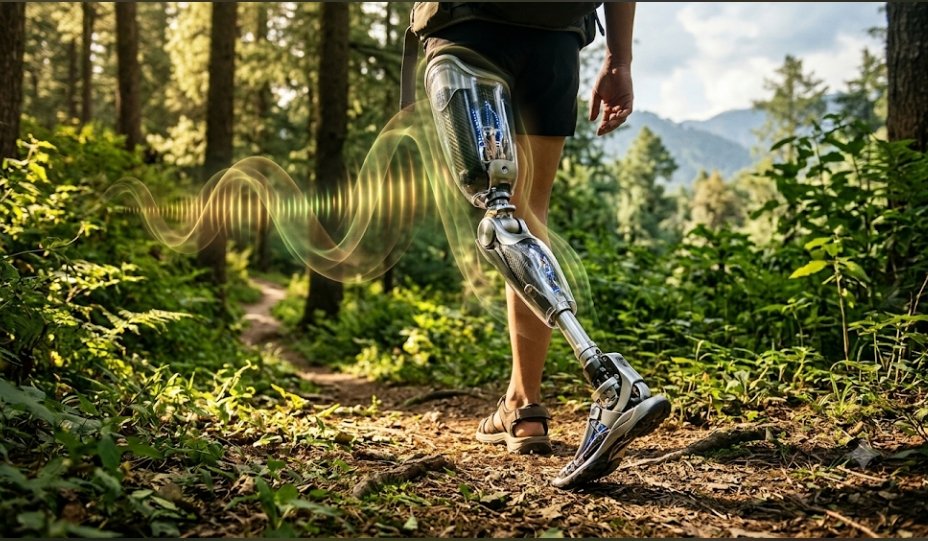
In March 2026, researchers at the University of Twente and Radboud University Medical Center in the Netherlands unveiled a bionic foot that does something remarkable: it restores a natural walking pattern without requiring the user to consciously control every step. It is not a passive piece of plastic and metal. It is an intelligent system—a partner in motion.
The secret lies not in the materials, but in the mathematics of the spinal cord itself.
The Rhythm That Lives in Your Spine
The Central Pattern Generator
Deep within your spinal cord, beneath the level of conscious thought, there exists a network of neurons that has been orchestrating movement for hundreds of millions of years. Neuroscientists call it the Central Pattern Generator (CPG) .
The CPG is a neural circuit that can produce rhythmic, coordinated patterns of muscle activation without requiring input from the brain for every single movement. It is the reason a newborn foal can stand and walk within hours of birth. It is the reason you can walk while your mind is elsewhere. The brain gives the command—walk—and the CPG handles the rhythm.
Research on human lumbar cord circuitries has demonstrated that even in individuals with complete spinal cord injury, electrical stimulation can induce stepping-like activity in the lower limbs. The pattern generator is still there, waiting to be activated. It is a biological metronome, a rhythm section that never forgets the beat.
The Problem with Passive Prostheses
Traditional prostheses ignore this rhythm entirely. They are passive devices—springs and dampers that respond to force but do not generate movement. They require the user to expend enormous cognitive effort to compensate for what the prosthesis cannot do. The result is a gait that is functional but fatiguing. A walk that is possible but not natural. A life that is lived, but not effortlessly.
As Professor Massimo Sartori of the University of Twente explains, the goal of the new bionic foot is to build a system that “functions as naturally and intuitively as possible, without requiring users to consciously control each step”.
This is not a small ambition. It is a fundamental reimagining of what a prosthesis can be.
The Neuromechanical Model — A Digital Spinal Cord
From Biology to Mathematics
The bionic foot developed by the Twente and Radboud teams does not simply mimic the shape of a foot. It mimics the logic of the nervous system.
The researchers created a neuromechanical model—a mathematical representation of how the spinal cord coordinates movement—that is inspired by the CPG. This model is driven by “synthetic muscle activations,” meaning it generates the patterns of muscle contraction that would naturally occur during walking, without requiring the user to produce those signals through their own residual muscles.
The system was tested on two individuals with transtibial amputations—one using a socket-suspended prosthesis and the other using a bone-anchored prosthesis. The results were striking. The model’s predicted torques aligned with those measured from the intact limb, with a root-mean-square error of just 0.52 ± 0.3 Nm/Kg and a correlation coefficient of 0.52 ± 0.4. The control system effectively modulated joint torques in both timing and amplitude across three different walking speeds, from 0.55 to 1.1 meters per second.
In simpler terms: the bionic foot learned to walk like a human foot, at different speeds, without being explicitly told how.
The “Autonomous Leg”
The project is called the “Autonomous leg” —a name that captures its ambition. Unlike a passive prosthesis or a device built on fixed movement rules, the Autonomous leg is designed to generate rhythmic walking movements automatically, just like a healthy human leg.
The early tests were conducted on a treadmill, with the model connected to an external computer. The next step is to create a fully stand-alone, mobile system with integrated sensors, a compact computer, and a long-lasting battery. Only then can the team test the prosthesis in real-life environments—at home, on the street, on natural terrain.
This is the crucial threshold. A laboratory demonstration is a proof of concept. A device that works in the real world is a life-changer.
The Cognitive Liberation
The Fatigue of Forced Focus
There is a dimension of prosthetic use that is rarely discussed in clinical literature: the cognitive burden. When a prosthesis cannot generate natural movement, the user must consciously plan and execute every step. This is exhausting. It consumes mental bandwidth that could otherwise be devoted to work, relationships, creativity, or simply the experience of being alive.
Ruud Leijendekkers, associate professor and physical therapist at Radboudumc, notes that the new approach “could ultimately reduce fatigue by lowering the cognitive effort traditionally required when using a prosthesis”.
This is the promise of the Autonomous leg. It is not just a better foot. It is a liberation of attention. It returns to the user the mental space that walking once occupied. It allows them to think about something other than the next step.
The Neuroscience of Embodiment
There is a deeper principle at work here. The brain does not experience a prosthesis as a tool. It experiences it as a part of the body—or it does not. This sense of embodiment depends on the congruence between the sensory feedback from the device and the motor commands sent to it.
When a prosthesis moves in a way that is natural and predictable, the brain accepts it. The boundary between self and device blurs. The prosthesis becomes an extension of the self, not an external object to be managed. This is the neurological foundation of effortlessness.
The neuromechanical model is a step toward this embodiment. By generating movement that feels natural, it gives the brain the signals it needs to accept the bionic foot as its own.
The Future of Feeling
Sensory Feedback: The Missing Piece
Movement is only half of the equation. The other half is sensation.
When you walk, you feel the ground beneath your feet. You feel the pressure of each step, the texture of the surface, the angle of your ankle. This sensory feedback is essential for balance, for adaptation, and for the simple feeling of being grounded in the world.
Traditional prostheses provide no such feedback. The user must rely on vision and on the mechanical resistance of the device to infer what is happening beneath them.
Researchers are now working to close this loop. Projects like the EU-funded Natural BionicS initiative are developing neural interfaces that connect prosthetics directly to spinal cord circuitries, offering tactile functions that restore the sense of touch. Other groups are using vibrotactile and electrotactile actuators to deliver sensory information back to the user.
A 2026 bio-inspired ankle-foot prosthesis has even demonstrated tactile sensing capable of facilitating reflex control of toe-gripping during unexpected perturbations—a function that is essential for navigating uneven terrain.
The bionic foot of the future will not just move naturally. It will feel naturally.
The Meta-Pattern Generator
The next frontier is the integration of intention and execution. A 2026 study published in Biological Cybernetics proposes a Meta-Pattern Generator (MPG) —a dual-layer computational model that bridges the gap between the brain’s intention to move and the spinal cord’s execution of that movement.
While current bionic CPG models address the transformation from motor intention to spinal integration, the MPG adds a layer of physiological realism. It represents the spinal cord not as a simple pattern generator, but as a dynamic integrator that coordinates multiple streams of information—sensory, motor, and cognitive.
This is the architecture of a truly natural bionic limb. It does not just replicate the rhythm of the spinal cord. It replicates the conversation between the brain and the body.
The Deeper Meaning — A Meditation on Walking
We take walking for granted. It is so fundamental to human experience that we rarely pause to consider its complexity.
Yet walking is one of the most sophisticated achievements of the human nervous system. It requires the coordination of hundreds of muscles, the integration of sensory feedback from every joint and every inch of skin, and the rhythmic firing of neural circuits that have been refined over millions of years of evolution.
To restore walking after amputation is not merely a technical challenge. It is a restoration of a fundamental human capacity. It is the return of a birthright.
The bionic foot developed by the Twente and Radboud teams is a milestone in this restoration. It is not the final step. The fully autonomous, sensory-enabled, spinal-integrated prosthesis is still on the horizon. But it is a proof of concept. It is a demonstration that the rhythm of the spinal cord can be captured in silicon and steel.
And in that demonstration lies a profound truth: the body is not a machine to be replaced. It is a symphony to be continued.
Conclusion: The Return of Effortlessness
The greatest technologies are the ones that disappear. They become so integrated into our lives that we forget they are there. The bionic foot is moving toward this kind of invisibility.
When the model is fully mobile, when the sensory feedback is complete, when the spinal interface is seamless, the user will not think about their foot. They will simply walk. They will climb stairs, navigate uneven ground, and move through the world with the same ease that most of us take for granted.
That is the promise of the Autonomous leg. Not a better prosthesis. A forgotten one.
The rhythm was never lost. It was waiting in the spine. And now, it is being returned.
The rhythm of walking was never in your brain. It was in your spine. A new bionic foot is learning to listen to that rhythm—and returning the gift of effortless movement to those who lost it.
#BionicFoot
#CentralPatternGenerator
#NeuromechanicalModel
#AutonomousLeg
#ProstheticsInnovation
#CognitiveLiberation
#RestoringWalking
#FutureOfMobility
#DrSannjay
#SpinalRhythm