There are languages we’re never taught in school.
No alphabets. No grammar. No textbooks.
Just biology, energy, and human instinct.
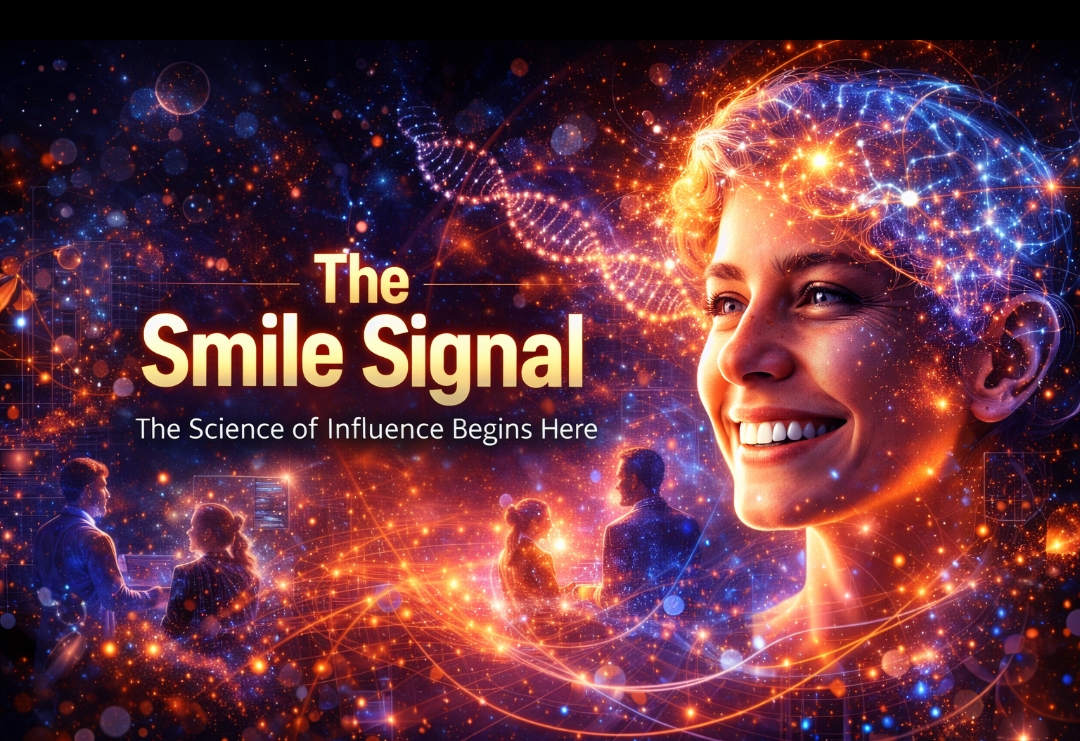
The smile is one of them. 🙂
Not the polite one.
Not the fake one.
Not the “camera smile.”
The real one. The nervous one. The grounded one. The calm one. The quiet one. The one that appears when your nervous system feels safe.
Here’s the truth most people miss:
A smile isn’t an expression.
It’s a signal.
Your brain reads it.
Other people’s brains read it.
Rooms read it.
Systems read it.
Markets read it.
Even conflict reads it.
Before a word is spoken, the nervous system of the other person already decides: Am I safe here? Am I respected here? Am I seen here? Am I threatened here? Am I in competition here?
This decision happens in milliseconds. No thinking. No logic. No analysis.
Pure biology.
This is where the science begins.
The human brain has something called mirror neurons.
They don’t care about your words.
They copy your state.
If your smile comes from calm, their body relaxes.
If your smile comes from insecurity, their body tightens.
If your smile comes from dominance, their body defends.
If your smile comes from presence, their body trusts.
So the smile is not about the mouth.
It’s about the nervous system behind the mouth.
That’s why two people can smile the same way and create completely different reactions.
One creates comfort.
One creates discomfort.
One creates authority.
One creates warmth.
One creates trust.
One creates resistance.
Same facial movement.
Different internal signal.
This is why leadership is not taught properly. Because leadership is not behavior. It’s regulation.
The most powerful leaders don’t look powerful.
They feel safe.
Their presence slows rooms down.
Their silence stabilizes chaos.
Their smile doesn’t seek approval.
It offers safety.
And humans are wired to follow safety.
Not intelligence. Not dominance. Not competence. Not credentials.
Safety.
This is why people choose warmth over brilliance. This is why people trust presence over performance. This is why calm always outlives charisma.
A regulated nervous system is more persuasive than a thousand techniques.
And a grounded smile becomes a social key.
It opens conversations. It dissolves defenses. It disarms egos. It stabilizes fear. It shifts power dynamics. It reframes negotiation. It rewires perception.
Not because it’s friendly. But because it tells the other system:
“You don’t need to protect yourself here.”
That’s rare.
We live in a world of guarded bodies, tense faces, rushed energy, performative confidence, and invisible fear.
So when someone enters with a regulated presence and a real smile, it feels like oxygen.
People don’t know why they trust you.
They just do.
People don’t know why they listen.
They just do.
People don’t know why they open up.
They just do.
Because their body decided before their mind.
This is the hidden layer of influence no one teaches.
Not persuasion. Not manipulation. Not strategy. Not tactics.
But coherence.
When your inner state, nervous system, breath, posture, eye contact, and smile align, you become readable to the human brain.
And the human brain trusts what it can read.
This is why the future of leadership is not louder voices. Not sharper branding. Not stronger dominance. Not louder authority.
It’s nervous system intelligence. Emotional regulation. Psychological safety. Energetic coherence. Human presence.
The next era of influence won’t look aggressive. It won’t look controlling. It won’t look performative.
It will look calm. It will look grounded. It will look warm. It will look stable. It will look human.
And the symbol of that future is simple:
A smile that doesn’t try to impress.
A smile that doesn’t seek validation.
A smile that doesn’t perform.
A smile that doesn’t manipulate.
Just a nervous system at peace.
Just a human in regulation.
Just presence.
Because the deepest truth is this:
People don’t follow intelligence.
They follow safety.
People don’t trust words.
They trust states.
People don’t respond to power.
They respond to coherence.
And the most underestimated signal of all is a real smile. ✨
Not because it’s soft.
But because it’s stable.
Not because it’s kind.
But because it’s regulated.
Not because it’s friendly.
But because it’s safe.
That’s the science.
That’s the psychology.
That’s the future.
And once you see it, you can’t unsee it.
Let’s go deeper. Not surface level. Not motivational talk. Not quotes.
Real biology. Real psychology. Real human science.
Because a smile isn’t a gesture.
It’s a full-body event.
The biology of a smile:
A real smile starts in the nervous system, not the face.
It begins in the vagus nerve, the main communication highway between your brain, heart, lungs, and gut.
When your nervous system feels safe, the vagus nerve activates parasympathetic mode (rest, trust, openness).
That signal moves upward and activates facial muscles automatically.
So the smile is not chosen.
It’s released.
That’s why forced smiles feel off.
They come from muscles, not the nervous system.
A genuine smile changes:
• heart rhythm
• breathing pattern
• voice tone
• eye movement
• posture
• micro muscle tension
• pupil response
• facial blood flow
That’s biology, not emotion.
Your body literally shifts chemistry:
Cortisol drops
Oxytocin rises
Serotonin increases
Dopamine activates
So when someone smiles genuinely, they aren’t just expressing happiness.
They’re broadcasting neurochemical safety.
And other nervous systems feel it instantly.
The psychology of a smile
Psychologically, the brain reads smiles as predictive signals.
Your subconscious asks: Is this person safe? Are they stable? Are they regulated? Are they threatening? Are they unpredictable?
A smile answers those questions faster than words ever can.
That’s why first impressions happen in seconds. That’s why trust forms before conversation. That’s why people “feel” comfortable before they know why.
Your mind doesn’t decide trust.
Your nervous system does.
A smile becomes a trust shortcut.
The anatomy behind it:
There are 3 key muscle systems involved:
• Zygomatic major (lifts the mouth)
• Orbicularis oculi (around the eyes)
• Frontalis (forehead and micro-expression control)
Fake smiles activate mainly the mouth.
Real smiles activate eyes + cheeks + breath + posture + micro-movements.
This is called a Duchenne smile in neuroscience.
That’s why we can “feel” real vs fake smiles without training.
Your brain reads the muscle map automatically.
Hidden facts no one talks about
Here’s what’s rarely discussed:
A smile changes power dynamics.
Not soft power.
Neural power.
A grounded smile:
• lowers defensive reflexes • reduces threat perception • increases openness • shifts hierarchy • dissolves competition • increases cooperation • rewires negotiation tone • changes authority perception
That’s why calm leaders dominate rooms quietly. That’s why composed people feel powerful. That’s why presence beats performance.
A regulated smile is dominance without aggression.
Will robots smile?
Yes.
But they won’t feel.
Robots can replicate muscle movement.
They cannot replicate nervous system coherence.
A robot smile will be:
• symmetrical • perfect • consistent • predictable • timed • programmed • patterned
A human smile is:
• asymmetrical • imperfect • adaptive • context-sensitive • emotionally responsive • biologically regulated • energetically variable
How to tell the difference?
Human smile changes: • breathing rhythm • eye moisture • micro tension • pupil dilation • vocal tone • body posture • micro pauses
Robot smile doesn’t.
It’s mechanical symmetry without nervous system noise.
The future paradox: Robots will smile better than humans. But they will never feel safe to the human nervous system.
Because safety is biological, not visual.
How to hack your smile (real way, not fake way)
Not by practicing in the mirror. Not by forcing expressions. Not by copying techniques.
You hack your smile by regulating your nervous system.
Simple human methods:
• Slow breathing before interaction
• Relaxed jaw and tongue
• Eye softening
• Shoulder drop
• Grounded posture
• Slower speech
• Lower vocal pitch
• Calm internal dialogue
• Stable attention
When your body is calm, the smile becomes natural.
You don’t create it.
You allow it.
Personal life impact:
A regulated smile:
• makes people open up faster • reduces conflict • increases emotional safety • deepens intimacy • builds trust faster • creates bonding • dissolves tension • increases attraction
People don’t fall for faces.
They fall for nervous system safety.
Professional life impact:
In business:
• increases deal closure • improves negotiations • strengthens authority • builds credibility • increases trust • improves leadership presence • strengthens influence • creates loyalty • shifts perception of power
Because people don’t buy logic.
They buy safety.
Reverse psychology of a smile:
Here’s the paradox:
Trying to smile to influence people makes it manipulative.
Not trying to smile makes it powerful.
The moment you need the smile to work, it stops working.
Because intention leaks through the nervous system.
The most powerful smiles are:
• unintentional
• unstrategic
• unforced
• unperformed
• uncalculated
They come from inner stability, not outer technique.
The deeper truth
A smile is not a social skill.
It’s a nervous system signature.
It tells the world:
“I am regulated.” “I am safe.” “I am stable.” “I am present.” “I am not a threat.” “I am not afraid.”
And the human brain follows those signals automatically.
So the future of influence isn’t better communication. It’s better regulation.
The future of leadership isn’t louder voices. It’s calmer nervous systems.
The future of connection isn’t charisma. It’s coherence.
And the future symbol of intelligence won’t be words. It will be presence.
Because in the end:
People don’t respond to faces.
They respond to states.
People don’t trust expressions.
They trust nervous systems.
People don’t follow smiles.
They follow safety.
This isn’t psychology as theory.
This is biology as truth.
This is human science.
This is the next layer of leadership.
This is the unseen architecture of influence.
And once you understand it,
you stop trying to impress,
and start becoming stable.
That’s where real power lives.
🙂🌍🧠✨
#ScienceOfSmile #HumanPsychology #FutureLeadership #NeuroIntelligence
#HumanBehavior #PsychologicalSafety #ConsciousLeadership #MindScience
#HumanConnection #FutureOfWork #EmotionalIntelligence #PresencePower
#GlobalMindset #LeadershipEvolution #HumanCentered #NeuroLeadership
#InnerStability #RegulatedMind #FutureHumans #NextEraThinking